The Book Light That Won't Wake Your Spouse — Buy It on Colour, Not Brightness
August 20, 2026
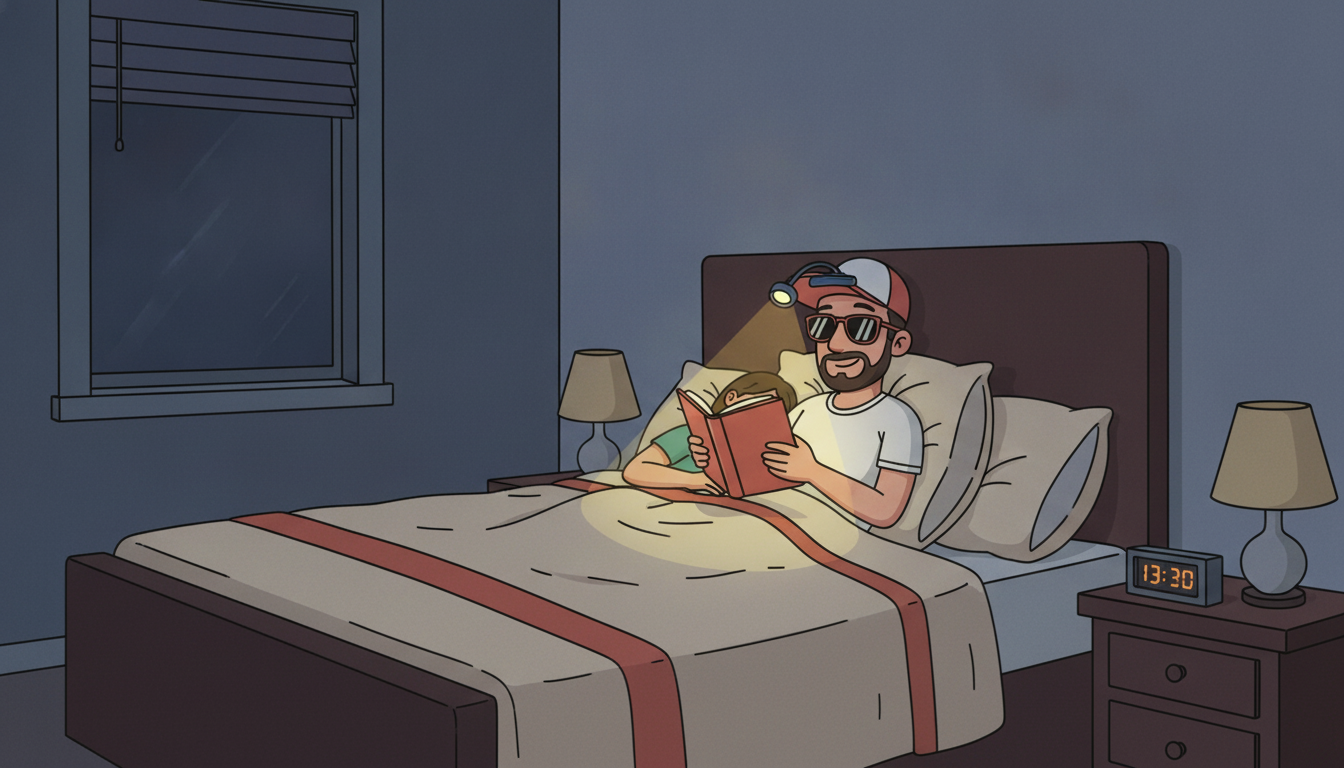
Here’s a problem I know well. It’s late, you’re not tired, and there’s a chapter left. But the person next to you is fast asleep, and clicking on the lamp would be a crime. So you lie there. Wide awake. Sad.
I’ve bought four of these things over the years. The first three were wrong, and they were wrong for a reason I didn’t understand until I stopped shopping by brightness.
There are two problems here, and only one is about brightness
This is the bit every “best book lights” list runs together, and it’s why people buy the wrong one.
Problem one is the person beside you. That’s not about colour at all. That’s about spill — how much light escapes the page and lands on the room, the ceiling, the pillow next to yours. A light that aims down into a tight pool on the paper can be reasonably bright and still not reach Dee’s side of the bed. A light with a wide, unshielded glow can be set low and still wash the whole headboard. Direction beats output, every time.
Problem two is your own sleep, an hour later, when you finally put the book down. That one is about colour. And it’s the one with real science under it.
Keep them separate when you shop and the choice gets a lot simpler.
The colour number to look for
Light gets measured in Kelvin. Low numbers are warm and orange, high numbers are cold and blue-white. Candlelight sits around 1900K. A harsh white LED is up around 6000K.
Here’s why that matters at midnight. There’s a set of cells in the back of your eye that don’t do vision at all — they just tell your brain what time of day it is. A 2017 paper in Ophthalmic & Physiological Optics by Lisa Ostrin, Kaleb Abbott and Hope Queener puts the mechanism plainly: these cells run on a pigment called melanopsin, and melanopsin “is most sensitive to short wavelength light, with a peak sensitivity of ~482 nm.”
482 nm is cyan-blue. It’s right in the middle of what a cold white LED throws at you. So a bright blue-white book light is, as far as those cells are concerned, a small sunrise six inches from your face.
Now put a number against the alternatives. That Gritin light’s amber mode runs 1800K. The GembaRed red one publishes its actual wavelength — 630 nm specified, 640 nm peak — which lands about 150 nm away from where those clock cells are most sensitive. You don’t need to care about the physics beyond this: the further your light gets from blue, the less it argues with your own sleep.
What you want on the box is a warm or amber mode, in Kelvin, with a real dimmer. What you don’t need is a lumen figure. Nobody has ever been kept awake by insufficient lumens.
The clamp is what actually breaks
I build houses for a living, so forgive me, but this is a bracket problem and most of these are badly designed brackets.
The clip has three jobs and they fight each other. It has to grip a floppy paperback cover without creasing it. It has to open wide enough for a hardcover, which is four or five times thicker. And it has to hold on an e-reader in a case, which is smooth plastic with nothing to bite. Most cheap clips do one of those three well.
Two things to look for. Non-slip pads in the jaw — bare plastic on a glossy cover slides, and it slides at the worst moment, which is when you’ve nearly dropped off. And a gooseneck that holds its shape, because the whole point of positioning the light is that it stays positioned. A neck that slowly droops over twenty minutes will have you fixing it four times a chapter, and you’ll put the book down just to stop fiddling.
The other number worth a glance is weight. The Gritin is 71 grams. Clipped to the cover of a mass-market paperback that’s already trying to close itself, 71 grams is noticeable and about the ceiling of what’s pleasant. Anything heavier belongs on a hardcover or clipped to the headboard instead of the book.
And if you’re reading on a Kindle or a Kobo rather than paper, you may not need any of this — those have their own front light with a warm setting built in, and I’ve gone through which one actually survives a week near water separately.
Rechargeable or batteries
Short answer: rechargeable, if it lives on a nightstand.
The case for coin cells used to be that they were tiny and you could keep spares in the suitcase. That was a real argument when rechargeable clip lights ran four hours. It isn’t anymore. The Gritin packs a 1200 mAh battery and Gritin rates it at 12 to 90 hours depending which colour mode and brightness you run, off a two-hour charge. On the amber setting at a sane brightness — the way you’d actually use it — that’s weeks of bedtime reading between plugs.
Where coin cells still win is the thing you throw in a bag and forget for a year. A rechargeable light that’s been dead in a drawer since last summer is useless on the first night of a trip; a coin-cell one just works. If that’s the job, buy the cheap battery one and keep it packed. For the light that sits beside your bed every night, rechargeable, and leave the cable on the nightstand.
So what would I buy
For most people, the Gritin. It’s the inexpensive one and it’s also the one with the best spec sheet, which almost never happens. The amber mode at 1800K is the one you’ll live on, the dimmer actually goes low, and the clip has the non-slip pads. Four-point-eight stars across more than forty-one thousand reviews is about as close to a safe bet as this category offers.
Pay more for the NoBlue if you’re the type who’d hit the wrong button. Its whole feature is that it has no cold mode. There’s no white setting to land on by accident in the dark, and if you’ve ever blinded yourself and your partner at 1am reaching for a dimmer, you know exactly why that’s worth twenty-nine dollars.
Buy the GembaRed if the person beside you wakes at anything. Red is the gentlest glow there is. Be honest with yourself about the trade: it is dim, and red light on white paper takes some getting used to. If you read small print, or your eyes aren’t what they were — mine aren’t — go amber instead and accept that you need the room darker.
Here’s the catch nobody mentions, and it applies to all three. Warm light is dimmer than harsh white light at the same power draw. That’s not a defect, it’s the deal. And none of these will light up a tent or a whole room. One reader, one page, one quiet hour. That’s the only job I’m asking them to do, and it’s the job that gets a book finished.
Clip it to the cover. Go read the chapter. Nobody wakes up, and the book that’s been keeping you up finally gets read — which, for me, is usually an hour before anybody else in the house is conscious anyway.